
Adapted from a SPARDER Chinese industry article first published on 16 July 2025. This English version focuses on the official approval and practical food-formulation checks. It is not a finished-product launch or a health claim.
China's National Health Commission (NHC) announced D-allulose among five approved novel food ingredients in its 2025 No. 4 announcement, published on 2 July 2025. For food-development teams, the relevant question is not simply whether “allulose is approved”, but whether a particular material, use, serving and label match the announcement.
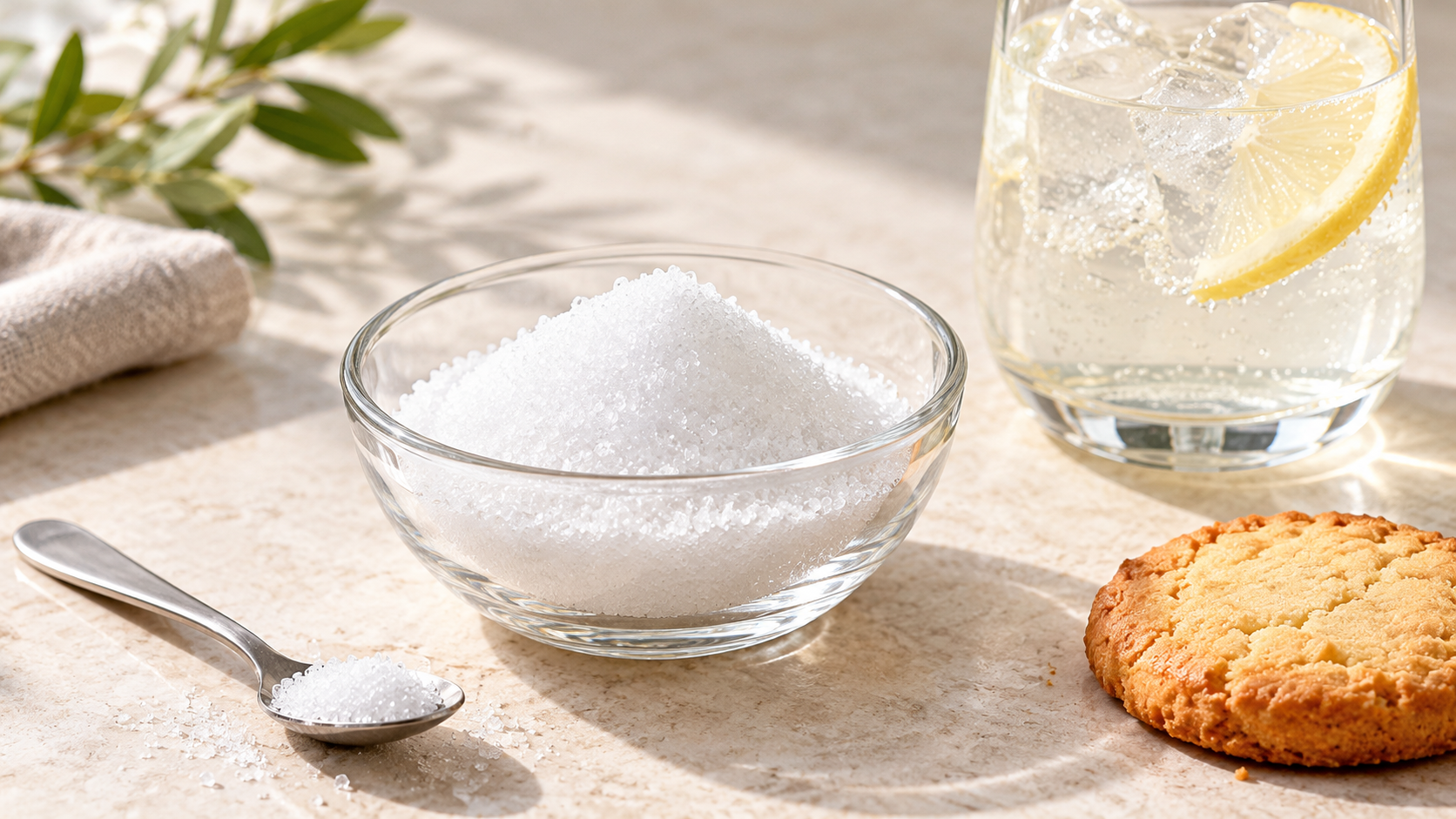
Conceptual editorial image. It is not an authenticated photograph of D-allulose, a SPARDER material lot or a finished product.
What the NHC approval says
The NHC's interpretation describes a D-allulose ingredient with a content of at least 98 g per 100 g, produced either by the specified microbial-fermentation route or by an enzyme-conversion route. It gives an energy factor of approximately 1.67 kJ/g and a recommended intake of no more than 20 g per day. The interpretation also states that infants, pregnant women and breastfeeding women are not suitable users because the available safety information for those groups is insufficient.
Ingredient production, food use, safety specifications and labeling must follow the official announcement and applicable food-safety rules. Approval of the specified ingredient does not establish that every supplier's material, food category, product claim or export destination is automatically permitted.
Questions for a food-formulation brief
Ingredient identity: verify the production route, specification, assay method and batch certificate against the approved material.
Serving and use: calculate the allulose contribution from the complete formula and expected daily consumption; check the relevant food category and labeling requirements before sampling.
Product performance: pilot-test sweetness balance, dissolution, browning, texture and shelf life in the actual beverage, confectionery or baked-food matrix rather than assuming direct one-for-one sugar substitution.
Target market: review each destination's current ingredient status and nutrition-label rules separately. China's approval does not transfer to another jurisdiction.
Statements about blood glucose, body weight or other physiological effects need separate product-specific evidence and authorization. The NHC approval is an ingredient-safety and use decision, not a general finished-product efficacy endorsement.
Official sources: NHC 2025 No. 4 announcement and NHC interpretation of the D-allulose approval. Check the annex and latest rules when developing a commercial product.
 Return