
Editorial update to a SPARDER Chinese technical note first published on 19 June 2024. This article discusses an ingredient and food-formulation checks; it does not describe a finished product or make a health claim.
Blueberry anthocyanins are pigment compounds extracted from blueberries. For a food-development team, the useful questions are less about broad wellness promises and more about ingredient identity, processing stability, permitted applications and batch documentation.
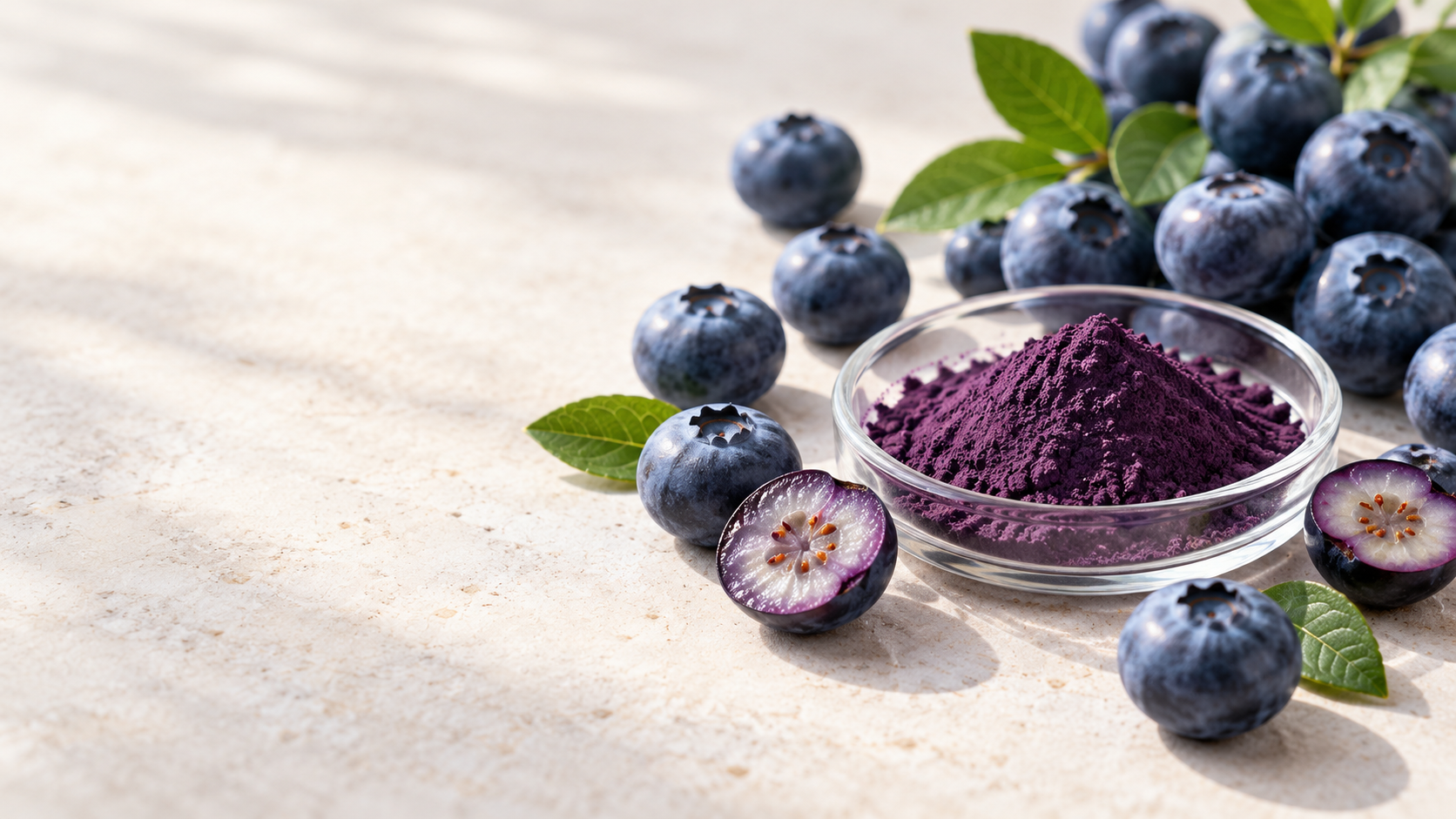
Illustrative image created for this article; not a photograph of SPARDER raw materials or a finished product.
What China's 2023 announcement actually covers
China's National Health Commission (NHC) announced blueberry anthocyanins as a novel food ingredient in 2023. The specified material is made from the fruit of Vaccinium corymbosum L. through the processes described in the announcement. The NHC's interpretation uses a 40% total-anthocyanin specification when explaining its recommended daily intake of up to 800 mg; a material with a higher content is calculated against its actual anthocyanin content.
That announcement is not a blanket approval for every format. Its annex names food categories and maximum use levels, including specified dairy products, beverages, jelly, confectionery, frozen desserts and baked goods. The label must also state that the ingredient is not suitable for infants, pregnant women or breastfeeding women. A proposed recipe must be checked against the exact category, use level, daily intake and label requirements before release. The Chinese approval does not automatically establish permission in another country.
Formulation checks before selecting a format
Published experimental research shows that blueberry anthocyanin colour and retention can change with pH, temperature and light. These findings are formulation inputs, not proof that a particular finished product is stable. A development brief should therefore define the intended food category and serving size, then test the actual ingredient lot in the chosen matrix and process.
Identity and specification: confirm botanical source, extraction process, total anthocyanin method, composition profile and batch certificate of analysis.
Processing: compare colour and assay retention before and after the proposed heat and mixing steps; document pH and water activity where relevant.
Packaging and shelf life: evaluate exposure to light and oxygen in the selected pack and verify stability under realistic storage conditions.
Regulatory fit: check the exact market, food category, maximum use level, serving size and mandatory label wording. Do not assume that a capsule or softgel is within the ordinary-food categories listed in the Chinese announcement.
What this does not claim
Research interest in anthocyanins must not be translated into an eye-health, disease-treatment or other finished-product efficacy claim without product-specific evidence and applicable authorization.
Sources: NHC interpretation of the 2023 novel-food announcement; NHC published annex with use categories and limits; experimental study on blueberry anthocyanin stability. Source information should be checked against the latest applicable rules at the time of commercialization.
 Return