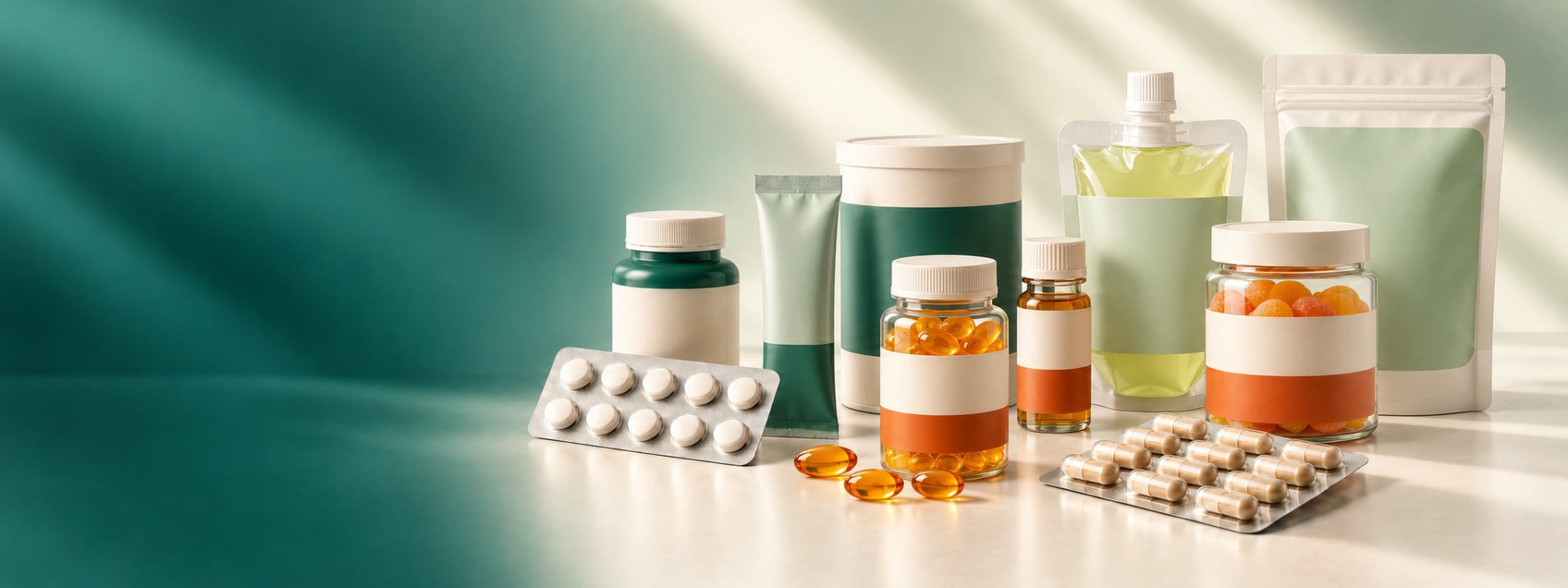
B2B Nutrition Product OEM/ODM Services

Softgels suit oil-soluble, oxidation-prone, light- and oxygen-sensitive, or poorly tasting ingredients: fish and algal oil, vitamin E, CoQ10, lutein esters, oil-borne botanical extracts. The advantages are complete taste masking, precise dosing, strong shelf recognition, and easier swallowing than large tablets.
Typical flow: gelatin melting → holding and deaeration → encapsulation → drying-drum curing → washing → sorting → final drying → primary packaging → secondary packaging.
Key control points. Gelatin melting: the ratio of gelatin, glycerine and water sets elasticity and oxygen barrier; excessive temperature or holding time degrades gelatin and makes the shell brittle. Drum drying: shell moisture governs appearance — too dry and it cracks, too wet and it sticks; temperature and humidity control at this stage is decisive. Fill moisture and pH: water carried by the fill and acidic ingredients both accelerate gelatin hydrolysis, so compatibility has to be assessed at formulation stage. Encapsulation: fill-weight variation and seam strength are the two variables; weak seams are the first cause of leakage.
Common failure modes. Leakage from weak seams, thin shell, or a fill that swells the shell; sticking from high surface moisture or uncontrolled storage conditions; clouding from moisture migration or poor compatibility; brittleness from low glycerine ratio or over-drying; uneven colour from poorly dispersed colour paste or uneven titanium dioxide distribution.
Pack selection. Aluminium blister for unit dosing and moisture protection; plastic bottles for everyday retail and e-commerce; foil bags for bulk and larger formats.
What buyers should check. SC licence scope covering the intended category; ISO 9001 / ISO 22000 / HACCP / FSSC 22000; and for softgels specifically — disintegration, fill-weight variation, peroxide value for oils, microbiological results, and three-month accelerated plus long-term stability.
You also want to know...
If there is any infringement, please contact us for removal.