
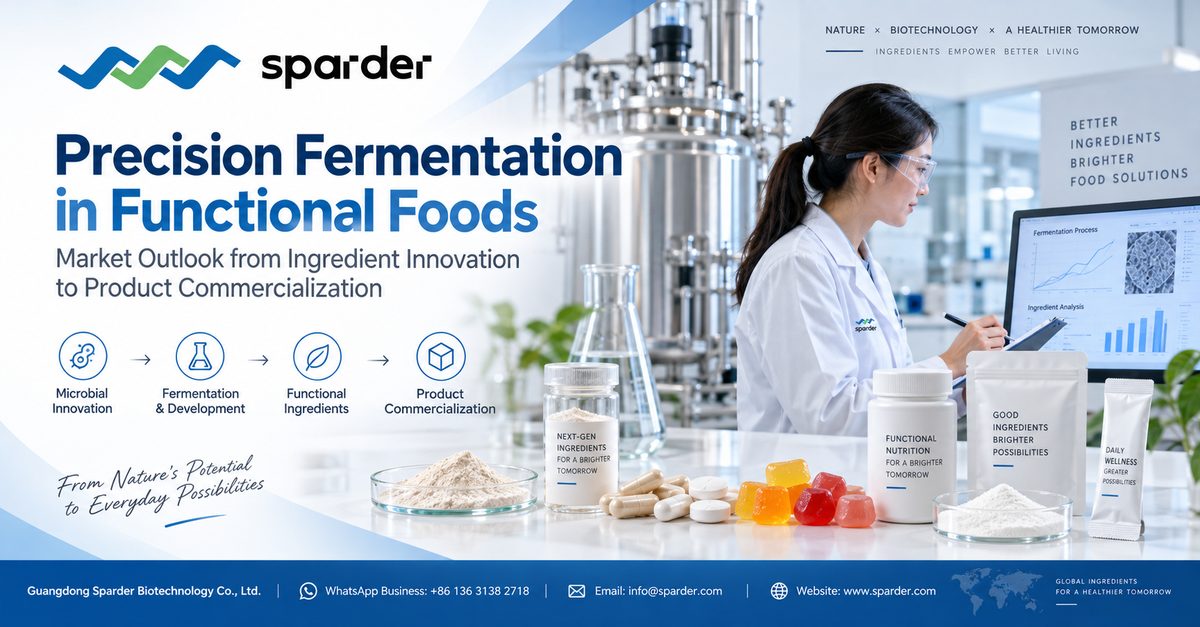
Precision fermentation is becoming one of the most discussed technologies in food biotechnology.
And the opportunity is real.
Microorganisms can increasingly be designed to produce targeted proteins, lipids, enzymes, vitamins, flavours and other high-value food ingredients under controlled conditions. Recent 2026 research continues to highlight its potential across functional ingredients and more resilient food-production systems.
But from a commercial manufacturing perspective, we believe the most useful question is not:
“How big will precision fermentation become?”
It is:
“Which ingredients actually make economic and product sense to produce this way?”
That distinction matters.
Not every ingredient needs precision fermentation
If an ingredient is already abundant, inexpensive and easy to standardise through conventional supply chains, replacing it with a complex fermentation process may create little commercial value.
Precision fermentation becomes more interesting when it solves a real problem.
For example:
when the natural source is limited,
when consistent specifications are difficult to maintain,
when the target compound occurs at low concentrations,
when supply is vulnerable,
or when the ingredient has enough value to support the economics of fermentation and downstream processing.
A 2026 review on minimum viable products in precision fermentation makes exactly this point: commercial targets need to combine market need, biological feasibility, regulatory feasibility, economics and scalability. Only a limited number of precision-fermentation-derived food ingredients have reached commercial markets so far.
This is why we see the market developing selectively rather than all at once.
Functional foods may be one of the more logical early markets
Functional foods and dietary supplements are different from commodity foods.
Ingredient cost still matters.
But value is also created by:
specification, functionality, differentiation, consistency and supply reliability.
That creates more room for high-value fermentation-derived ingredients.
Research already discusses applications across proteins, lipids, enzymes, vitamins, carotenoids and other functional compounds.
For a supplement brand, however, the technology itself should never be the only reason to use an ingredient.
The real question is:
What does this production method improve for the final product?
A better supply option?
A more consistent specification?
Access to a difficult-to-source molecule?
A new formulation opportunity?
A more differentiated product concept?
If none of those are clear, “precision fermented” is simply another technical label.
Cost will decide how large the market becomes
This may be the biggest reality check for precision fermentation.
Making a compound in a laboratory is not the same as manufacturing it competitively at commercial scale.
Fermentation productivity matters.
Feedstock matters.
Energy matters.
But downstream processing can matter just as much.
The ingredient may still need to be separated, filtered, purified, concentrated and dried after fermentation.
Current research identifies techno-economic analysis and downstream processing as major bottlenecks in translating precision fermentation into commercial food ingredients.
So the future winners will not simply be the companies with impressive microorganisms.
They will be the companies that can deliver:
a defined food-grade ingredient, at consistent quality, at an economically workable cost.
Regulation will determine the speed of adoption
A fermentation-derived ingredient is not automatically approved simply because the technology is innovative.
Regulatory assessment depends on the actual ingredient, production organism, manufacturing process, intended use and target market.
In the United States, microbial-derived ingredients may follow different regulatory pathways depending on the specific substance and use, including applicable food-additive or GRAS frameworks. FDA is also moving toward greater transparency in the GRAS system.
In Europe, ingredients from new sources or new production technologies may also need to be evaluated under the Novel Food framework depending on the specific case.
For brands, that means precision-fermentation sourcing needs to start with:
ingredient identity and regulatory status — not just a technology story.
Consumer acceptance is still developing
Another important market constraint is consumer understanding.
According to GFI's 2026 industry report, only about one in five surveyed U.S. consumers in its 2025 research had heard of precision-fermentation-derived or related proteins. However, willingness to try was higher after consumers received a short explanation of the technology.
A 2026 review of consumer perception also found that acceptance is highly context-dependent and that uncertainty around the technology remains.
This suggests something important for brands:
Consumers do not necessarily need “precision fermentation” to be the headline.
They need a product they understand and want.
Technology should support the product proposition — not overwhelm it.
The commercial opportunity may be “high value first”
Our current view is that the near-term opportunity is more likely to appear in:
high-value ingredients with a clear use case
rather than broad replacement of conventional ingredients.
That could include selected proteins, speciality lipids, vitamins, enzymes, carotenoids and other functional compounds where the technology creates a genuine supply or product-development advantage.
This does not mean precision fermentation will replace agriculture, extraction or conventional fermentation.
More likely, it becomes another production platform.
And that expands the ingredient toolbox available to product developers.
What does this mean for OEM/ODM manufacturers?
At Guangdong Sparder Biotechnology Co., Ltd., we are not a precision-fermentation ingredient producer.
Our role begins further downstream.
We support product development across:
Softgels | Tablets | Capsules | Gummies | Powders | Oral Liquids
So our interest in precision fermentation is very practical.
When a new fermentation-derived ingredient reaches the market, we need to understand:
Is it legally appropriate for the target market?
Is the specification clear?
Can it work in the intended dosage form?
What happens to taste and stability?
Can it survive the manufacturing process?
Does the supplier have enough capacity for repeat orders?
Can the product still meet its target cost?
This is where biotechnology becomes product development.
From ingredient innovation to commercial reality
The full commercialisation pathway looks more like:
Precision Fermentation
→ Ingredient Specification
→ Regulatory Review
→ Formulation
→ Dosage Form
→ Stability
→ Manufacturing
→ Market
Each step matters.
Skipping one does not make the project faster.
It simply moves the risk later.
This is why we believe OEM/ODM manufacturers will play an increasingly important role as new biotechnology-derived ingredients enter functional foods.
Someone still needs to translate the ingredient into a product that can be:
manufactured consistently, packaged practically and supplied repeatedly.
Our view at Sparder
Precision fermentation has meaningful market potential.
But its future will not be decided by technology excitement alone.
It will be decided by:
**Economics
Regulatory Clarity
Product Value
Consumer Acceptance
Manufacturing Feasibility**
When those conditions align, precision fermentation can create genuinely new opportunities for functional-food and supplement brands.
And that is the part we are watching most closely.
Not:
“What is the newest biotechnology?”
But:
“Which biotechnology is ready to become a real product?”
If you are evaluating a fermentation-derived functional ingredient for a new supplement project, share the target market, ingredient specification, dosage form and product concept for an initial manufacturing feasibility review.
 Return